 Rush Delivery: As soon as September 10


QUICK SUMMARY:
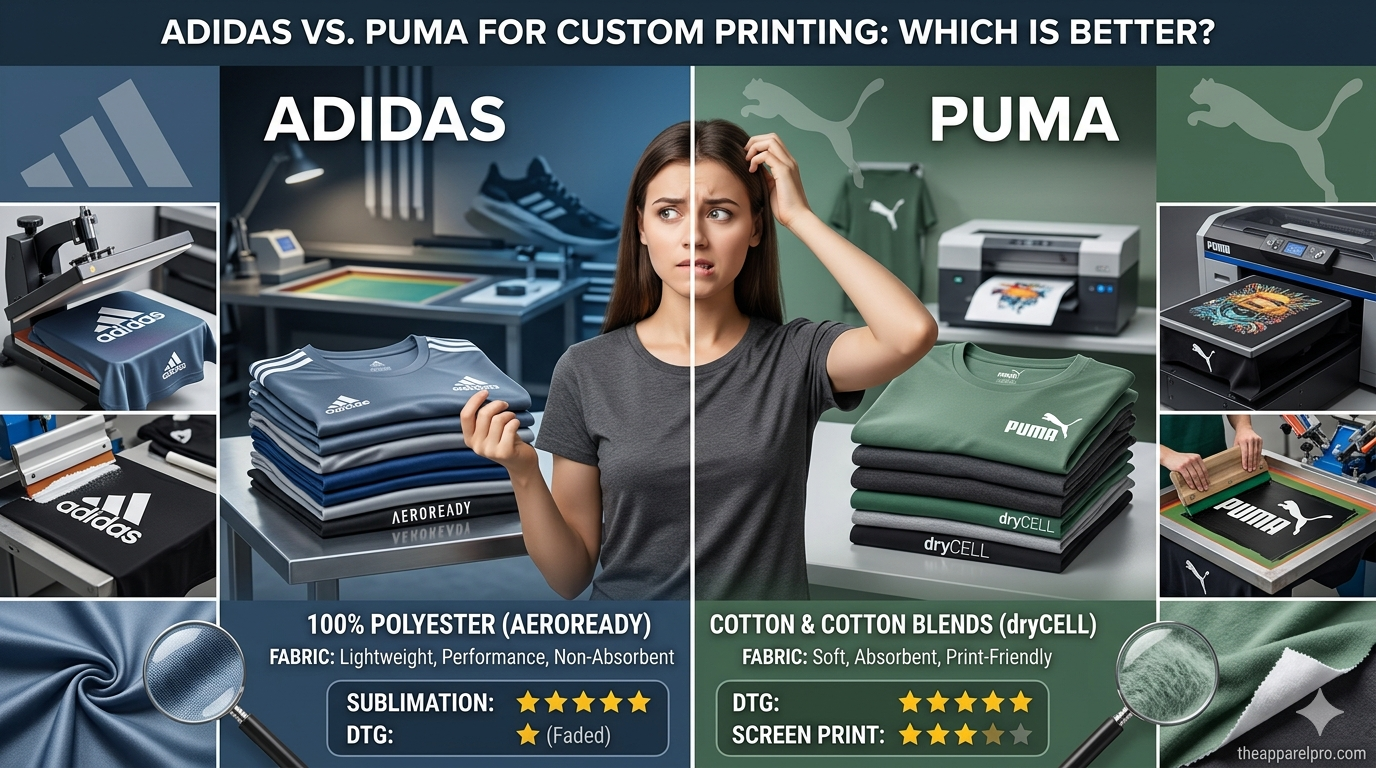
Instead of searching “Adidas vs Puma for custom printing,” or “Is an Adidas T-shirt better than a Puma T-shirt for custom printing? Ask yourself: “What is my design, and how will it be printed?”
- For bold, high-detail imagery, choose a performance-style base fabric that keeps colors sharp and use the digital Sublimation printing method.
- For a classic everyday logo and a comfortable feel, choose a natural-fiber base that allows for a soft, integrated finish, and use screen printing.
In the end, both brand products offer exceptional quality! It’s just like the ultimate success depends entirely on matching the right fabric with the right technique.
You have the perfect design in mind, with colors finalized and expectations running high. You even choose Adidas and Puma t-shirts, assuming both are high-quality options from globally recognized brands.
But when the final products arrive, something feels off. One print doesn’t look as sharp as you imagined, while the other turns out much better.
Naturally, this leaves you wondering, why the difference?
This is a common issue in custom T-shirt printing, and often, the problem isn’t the design; it’s the base shirt. While both brands are well-known, their fabric and print compatibility can vary significantly. What works perfectly for one design may not work as well for another.
So, how do you choose the right one from the start? Let’s compare Adidas and Puma from a printing perspective to help you avoid costly trial-and-error.
Adidas vs. Puma T-shirts: Ideal Choice for Custom Printing
At first glance, Adidas and Puma brand products seem like the perfect choice for custom printing. But when it comes to printing, what’s inside the fabric matters just as much as the logo on the outside. Take a look at the different factors that directly impact print quality:
Case 1: Polyester-Based T-Shirt (Adidas)
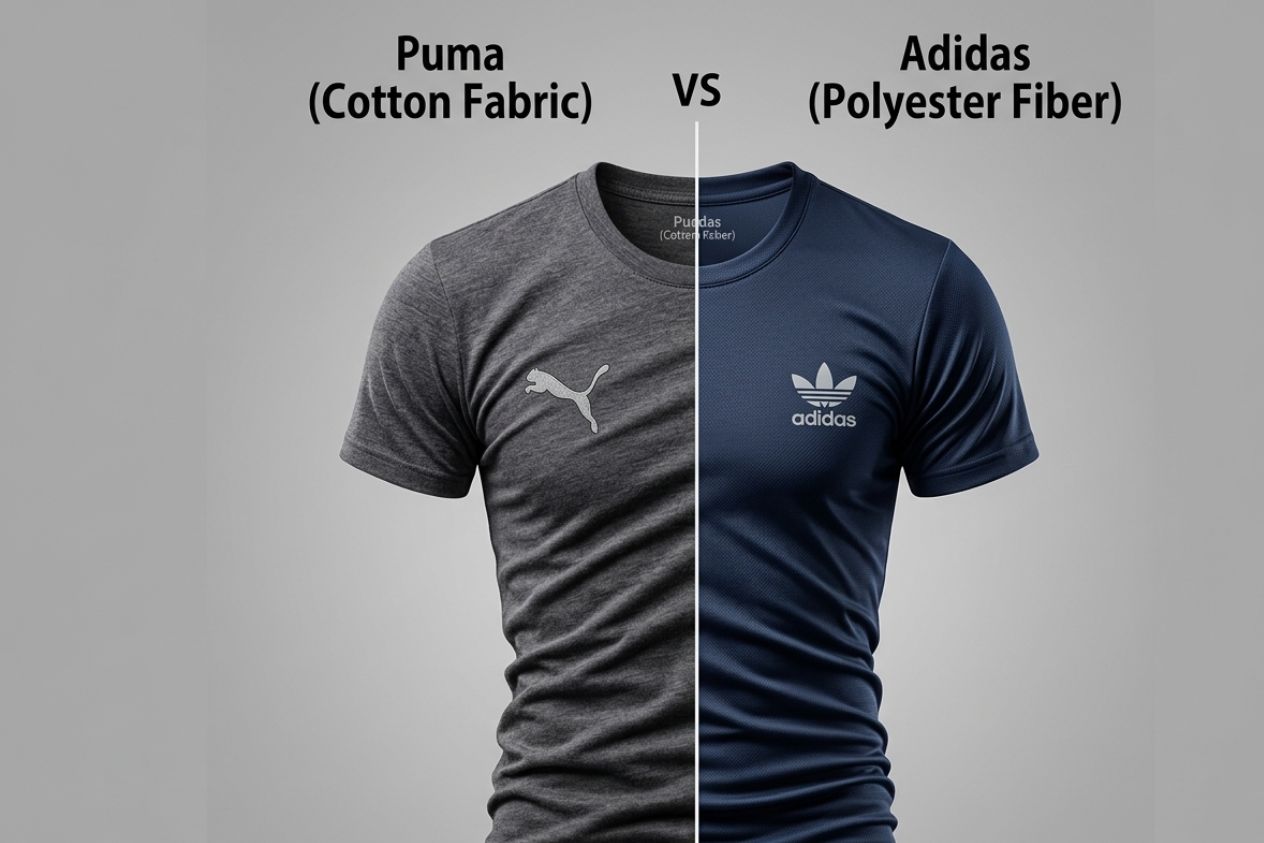
Suppose you choose an Adidas T-shirt made from 100% polyester (recycled) or a polyester blend. These fabrics are lightweight, smooth, and designed to keep you cool during workouts. That’s great for wearing… but when it comes to printing, things work a little differently.
Wondering why so?
Polyester doesn’t absorb ink the way cotton does. Instead, the ink tends to sit on the surface of the fabric rather than blending into it. Because of this:
- Colors may not look as rich
- Prints can feel slightly different on the surface
- The final result depends a lot on the printing method
If you already have a specific polyester fabric in mind, there’s no need to reject a brand because of it. Instead, you can choose a printing method that works best with that material.
Still confused about what this means?
Let’s simplify it. Not every printing method works equally well on every fabric. An Adidas T-shirt made from polyester may produce different results based on the printing method used. Refer to the table below for a clearer understanding.
| Printing Method | Compatibility | What to Expect |
|---|---|---|
| Sublimation Printing | ★★★★★ Excellent | Ink bonds directly with the fabric, giving sharp, long-lasting, and vibrant results |
| Heat Transfer | ★★★☆☆ Good | Works well for logos and simple designs with decent durability |
| DTF (Direct-to-Film) | ★★★★☆ Very Good | Bright results and works well on polyester with good flexibility |
| DTG (Direct-to-Garment) | ★☆☆☆☆ Not Recommended | Colors may look faded, less vibrant, and slightly “off” |
Why is DTG not ideal here?
Because DTG relies on ink soaking into the fabric, and as we discussed, polyester doesn’t absorb ink very well. So if you try a detailed or colorful design using the wrong method, the result may look:
- Faded
- Less vibrant
- Slightly “off” compared to expectations
Case 2: Cotton-Based T-shirt (Puma)
You pick a Puma T-shirt made from cotton or cotton-blend fabrics, such as 80% Cotton, 20% Polyester, for custom-printing purposes. Unlike polyester, 100% cotton and cotton-based fabrics are generally considered print-friendly. This means much more flexible for almost every printing method.
| Printing Method | Compatibility | What to Expect |
|---|---|---|
| DTG (Direct-to-Garment) | ★★★★★ Excellent | Sharp details, vibrant colors, and a natural finish as the ink absorbs well |
| Screen Printing | ★★★★☆ Very Good | Bold designs with strong durability; great for bulk printing |
| Heat Transfer | ★★★☆☆ Good | Clean and consistent results for simple designs |
| DTF (Direct-to-Film) | ★★★★☆ Very Good | Bright colors work well across cotton fabrics |
So when you print on it:
- Colors come out more vibrant
- Details look sharper
Because cotton absorbs ink better, you don’t have to worry as much about choosing the “perfect” method. Most standard printing techniques will give you consistent, high-quality results.
RECOMMENDATION: Looking for a platform where you can easily choose between Adidas and Puma products based on your size, fabric, & color preferences, and customize them? Choose The Apparel Pro. All you need to do is simply upload your design, whether it’s text, artwork, or a custom graphic, and get the desired final products you want.
Conclusion
Choosing between Adidas and Puma for custom printing isn’t as complicated as it seems. All you need is a smart approach. Start by deciding what matters most to you (fabric comfort or printing results) and then choose the right printing method accordingly.
When you match the fabric with the correct technique, you are far more likely to get the results you expect. Also, don’t forget that print quality depends not only on the T-shirt but also on the platform you choose for customization.
Frequently Asked Questions
Which is better for custom T-shirt printing, Adidas or Puma?
Both brands’ t-shirts are generally good for custom printing. Rest assured, all depends on the fabric technology and the printing method you intend to use, rather than the brand name alone.
Which fabric is best for custom T-shirt printing?
Cotton is generally the preferred choice for custom T-shirt printing because it absorbs ink effectively, allowing colors to appear vibrant and designs to remain crisp. Its soft and breathable texture also makes prints long-lasting and comfortable to wear, making it ideal for most printing methods.
Can you use DTG printing on polyester Adidas?
Yes, you can use DTG (Direct-to-Garment) printing on polyester material t-shirts, but it’s generally not the best choice. DTG works by soaking ink into the fabric, and polyester doesn’t absorb ink the same way cotton does. Because of this, the colors may appear faded, less vibrant, or slightly off compared to what you expected.
Which lasts longer, screen printing or DTG?
In most cases, screen printing lasts longer, especially for simple designs like logos or text. The ink sits on top of the fabric in thicker layers, making it more resistant to repeated washing. DTG, on the other hand, is great for detailed, multi-color designs because it blends into the fabric, but it may fade slightly faster over time if not properly cared for.
What should you prioritize first for custom T-shirts—brand or fabric?
Choosing the fabric first is the golden rule of custom apparel. While brands like Adidas and Puma offer prestige and style, the fabric composition is what determines whether your design looks like a professional masterpiece or a DIY disaster.