 Rush Delivery: As soon as April 11


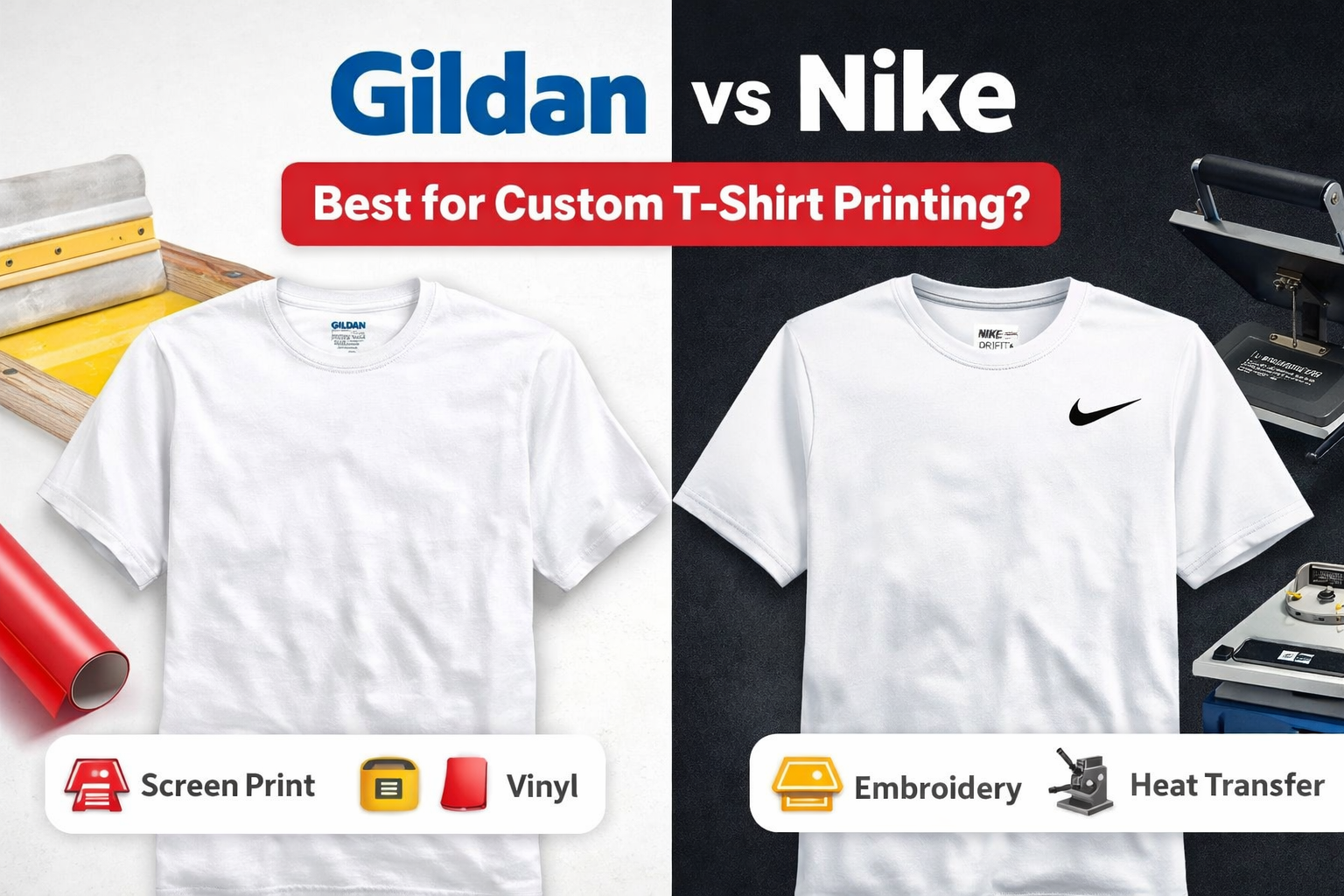
Choosing between Gildan and Nike usually comes down to two things: your budget and how you want the person wearing the shirt to feel. Gildan is the king of bulk events, while Nike is the standard for premium staff gear and athletic wear.
Choose Gildan If…
- You’re ordering for a bulk event (50–500+ shirts)
- Budget is a real concern
- You need large printed graphics that pop
- Recipients probably won’t care about the brand tag
- Screen printing or DTG is your decoration method
Choose Nike If…
- You’re gifting clients or top-performing staff
- Athletic or outdoor use is involved
- The Nike name on the tag matters to the wearer
- Embroidery is your preferred decoration method
Gildan vs Nike at a Glance
| Factor | Gildan | Nike | Winner |
|---|---|---|---|
| Price Range | $3–$8 per shirt | $20–$45 per shirt | Gildan |
| Best Printing Method | Screen printing, DTG | Embroidery, heat transfer | Depends on goal |
| Fabric Type | 100% cotton or cotton-poly blend | Polyester Dri-FIT or cotton | Depends on use |
| Shrinkage Risk | Moderate (pre-shrunk helps) | Low on poly; moderate on cotton styles | Nike (poly) |
| Fit Style | Relaxed / roomy | Athletic / contoured | Depends on audience |
| Durability | Strong across many washes | Strong; poly resists pilling | Tie |
| Brand Perception | Functional, no-frills | Premium, aspirational | Nike |
| Best Use Case | Events, uniforms, merch runs | Corporate gifts, staff rewards, sports | Depends on context |
Prices are general market estimates and vary by quantity, style, and supplier.
Also Read: How Much Do Custom T-Shirts Cost in Bulk?
Printing Compatibility: Which Brand Prints Better?
Gildan is the workhorse of custom printing—cotton-friendly, budget-smart, and built for big runs with bold graphics.
Nike is the brand you reach for when you want the shirt to feel like a reward, not a freebie. Both have a real place in a smart apparel strategy. The mistake is using one where the other belongs.
Gildan Printing Performance
Gildan shirts are usually 100 percent cotton or heavy blends. This makes them a dream for screen printing. The natural fibers soak up the ink, resulting in a vibrant and durable design.
Direct to Garment (DTG) printing also works best on Gildan because of the high cotton content. Just remember that dark colors require a white underbase layer of ink to make the colors pop.
If you’re looking for the best t-shirts for custom printing, Gildan’s high cotton content is hard to beat for screen printing and DTG alike.
Nike Printing Performance
Nike shirts are mostly synthetic polyester. Polyester is heat sensitive, which means it can scorch if the printing press is too hot. It also suffers from dye migration, where the shirt color bleeds into the white ink.
For the best t-shirts for logo printing on Nike, embroidery sidesteps all of these issues entirely. It doesn’t seal the fabric, doesn’t cause dye migration, and looks clean and professional on performance material.
Best Decoration Method by Brand
Gildan Works Best With
- Screen printing (best results)
- DTG printing (great for photos, complex art)
- Vinyl heat transfer (simple logos)
Nike Works Best With
- Embroidery (clean, professional, no dye migration)
- Stretch-compatible heat transfer vinyl
- Screen printing on Nike cotton styles only
Simple rule: If your logo has lots of color detail or gradients, go Gildan + DTG. If you want something that looks polished and corporate on an athletic shirt, go Nike + embroidery.
Comfort and Everyday Wear
Gildan Comfort:
Gildan’s standard cotton tees are breathable and soft, especially the 100% cotton Softstyle and Heavy Cotton lines. They feel familiar and comfortable in the way a good basic t-shirt should.
They’re not performance garments. In the heat, you will sweat and feel it. But for everyday casual wear, indoor events, or cooler climates, they’re genuinely comfortable to wear all day.
Nike Comfort:
Nike’s Dri-FIT fabric actually does what it claims. Sweat moves away from your skin and evaporates faster. If someone’s wearing this on a warehouse floor, a job site, or at an outdoor event, they’ll notice the difference.
One downside: performance polyester can trap odors differently than cotton. If shirts aren’t washed promptly after heavy activity, the smell can build up.
Legal Considerations When Customizing Nike Apparel
Nike’s brand guidelines restrict how their logo and name can be used. You cannot add your own logo directly next to the Nike Swoosh in a way that implies co-branding or partnership. Doing so without a formal licensing agreement creates legal exposure.
What you can do with most corporate Nike apparel programs is place your logo in an approved location—typically the left chest or sleeve—while the Nike branding stays where it already is. Your decorator should be familiar with these placement rules.
If you’re purchasing Nike through an authorized corporate decorator or a reputable custom apparel supplier, they’ll typically guide you through the approved placement zones. If anyone is telling you they can put your logo right next to the Swoosh for a co-branded look, ask them to show you the licensing agreement first.
Which Is Better? Here's the Honest Answer
Neither brand is universally better. They serve different goals. The question is what your goal actually is.
Gildan: The Smart Pick When…
- You’re printing at volume and need consistent results
- Screen printing or DTG is your decoration method
- The design is the product, not the brand name
- Budget matters, and every dollar needs to go further
- Fit diversity across a large group is a priority
Nike: The Smart Pick When…
- You want the recipient to feel like they got something valuable
- The shirt needs to survive athletic or outdoor use
- Embroidery is your decoration method
- Long-term brand visibility is the real ROI
- You’re ordering smaller quantities for a specific audience
When Companies Use Both Gildan and Nike Together
A lot of smart companies don’t pick one or the other; they use both for different audiences within the same program.
A common setup: Gildan for general staff uniforms (cost-effective, prints clean, holds up through repeated washing) and Nike for manager or leadership-level apparel (signals that there’s a tier difference worth earning). Some companies even use Gildan for all-hands event shirts and give Nike options as a performance bonus or milestone gift.
If you’re running a large or ongoing apparel program, this tiered approach gives you budget efficiency at scale while still having a premium option in your toolkit. A good custom apparel supplier like The Apparel Pro can help you structure a hybrid program that makes sense for your team size and budget.
Frequently Asked Questions
Does a large chest print block Nike Dri FIT moisture wicking?
Yes, a giant plastic ink print acts like a shield and stops air from flowing. If you put a massive logo on a Nike shirt, that spot will feel sweaty. Keep Nike logos small or use embroidery to let the fabric breathe.
Why do custom Nike shirts sometimes smell worse than cotton ones?
Polyester fibers are shaped in a way that traps oils and bacteria from your skin. While cotton absorbs moisture, polyester pushes it away but holds the oils. Using a specialized sports detergent usually fixes this problem.
Can a heat press scorch mark or press box be fixed on Nike polyester?
Sometimes a light steam can lift a press mark, but a true scorch mark is permanent. This happens when the heat is too high for the synthetic fibers. It is always better to use low temperature transfers on Nike gear.
Why did my Nike cotton shirt shrink more than my Gildan one?
Nike uses a more refined, thinner cotton for their non synthetic shirts. These can be more sensitive to high heat than the rugged, heavy cotton Gildan uses. Always wash custom Nike gear in cold water.
Is Nike sizing the same as Gildan sizing?
No, Nike is generally more “fitted.” A Gildan Large is usually wider and boxier than a Nike Large. If you like a loose fit, you might find Nike a bit too tight in the chest and arms.
Can I legally print my company logo next to the Nike Swoosh?
No, Nike is generally more “fitted.” A Gildan Large is usually wider and boxier than a Nike Large. If you like a loose fit, you might find Nike a bit too tight in the chest and arms.
Do I really need a white underbase when printing on dark Gildan shirts?
Yes, if you want the colors to be bright. Without a white layer underneath, the dark fabric color will soak into your ink. Your bright yellow logo will end up looking like a muddy forest green.
Will embroidery pucker thin Nike performance shirts?
It can if the design is too dense. Large, heavy embroidery pulls on thin fabric and creates wrinkles around the edges. Keep your embroidered logos simple and light for the best look on thin material.
Will Nike athletic fit look bad on different body types?
It can be challenging for a large group. The athletic cut is designed for a specific shape. If you have a team with very diverse body types, Gildan is usually the “safer” pick for everyone to feel comfortable.
Can I fix a peeling heat transfer logo on Nike shirts using a household iron?
You can try, but it is risky. Use a piece of parchment paper between the iron and the logo. Use medium heat and press down hard for 10 seconds. Be careful, as a home iron can easily melt the Nike polyester fabric.
Do I really need a white underbase when printing on dark Gildan shirts?
Yes, if you want the colors to be bright. Without a white layer underneath, the dark fabric color will soak into your ink. Your bright yellow logo will end up looking like a muddy forest green.