 Rush Delivery: As soon as November 07


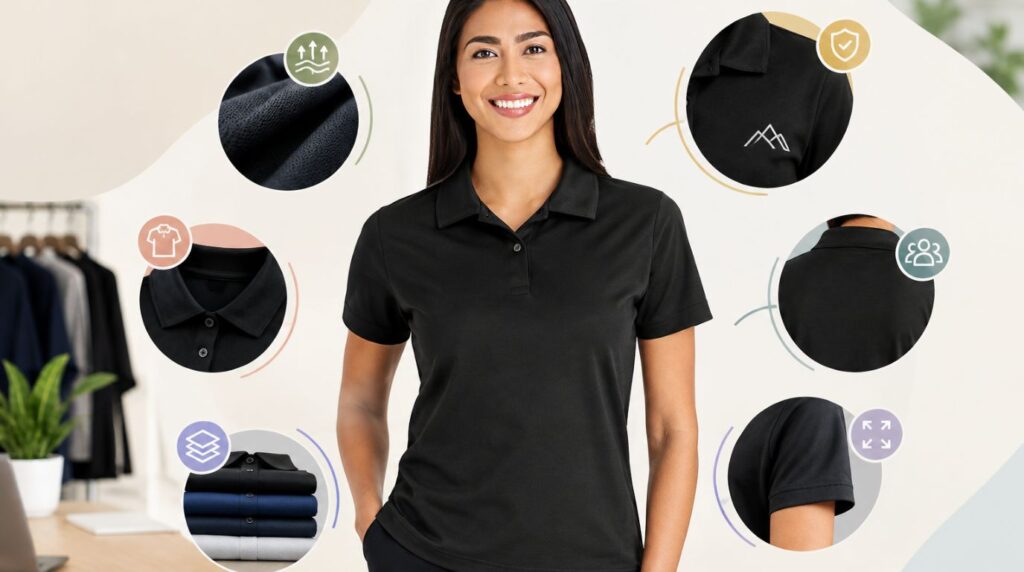
Are your employees actually wearing the uniforms you spent thousands on, or are they shoved in the back of a closet because they’re “too scratchy” or “fit weird”?
If you’ve ever dealt with logos that peel, shirts that shrink after one wash, or a “professional” uniform that makes your team look like they’re wearing oversized pajamas, you aren’t alone. These mistakes are common, but they are also expensive.
At Apparel Pro, we see these pitfalls every day. The good news? They are all fixable. Here are the 7 biggest mistakes businesses make with custom workwear and how you can avoid them to ensure your team looks: and feels: like pros.
1. Choosing the Wrong Fabric for the Job
Think about your team for a second. Are they climbing ladders? Running between jobs? Working outside in the summer? Greeting customers at a front desk? Their uniforms should fit the reality of their work, not just look nice in a product photo.
For active jobs, breathable and moisture-wicking fabrics can help keep employees more comfortable. For customer-facing roles, a neat polo or structured work shirt can give the team a more polished look. There is no single “perfect” fabric for every business, and that’s actually a good thing. You can build custom employee uniforms around what your team really needs.
A 100% heavy cotton tee might be great for a casual event, but it’s a nightmare for a technician working in the St. Louis summer heat.
- The Mistake: Ordering “standard” cotton for high-activity roles or cheap synthetics that don’t breathe.
- The Fix: Match the fabric to the activity.
- For physical/outdoor work: Choose moisture-wicking performance polyesters or “tri-blends” that offer stretch and breathability.
- For office/retail: Stick to high-quality custom polo shirts in piqué or jersey knits that hold their shape.
Pro Tip: Always check the “hand feel.” If a sample feels rough to you, it’s going to be unbearable for an employee wearing it for an 8-hour shift.
2. Bad Logo Placement (The "Armpit" or "Belly" Logo)
A beautifully designed logo can still look a little… lost if it’s sitting too low or awkwardly close to the sleeve.
For work shirts with a company logo, the left chest is a classic for a reason. It’s easy to see, looks professional, and doesn’t overpower the shirt. You can also use the sleeve or back for additional branding when the garment and design call for it.
A great logo in the wrong place looks amateur. We often see designs that are placed too low, making the logo sit on the stomach rather than the chest, or shifted too far toward the armpit.
- The Mistake: Not accounting for how the garment sits on a real person vs. a flat digital mockup.
- The Fix: Use the “four-finger rule” for chest logos: typically about 7 to 9 inches down from the shoulder seam and centered between the buttons and the armhole.
3. Overcomplicating Designs for Embroidery
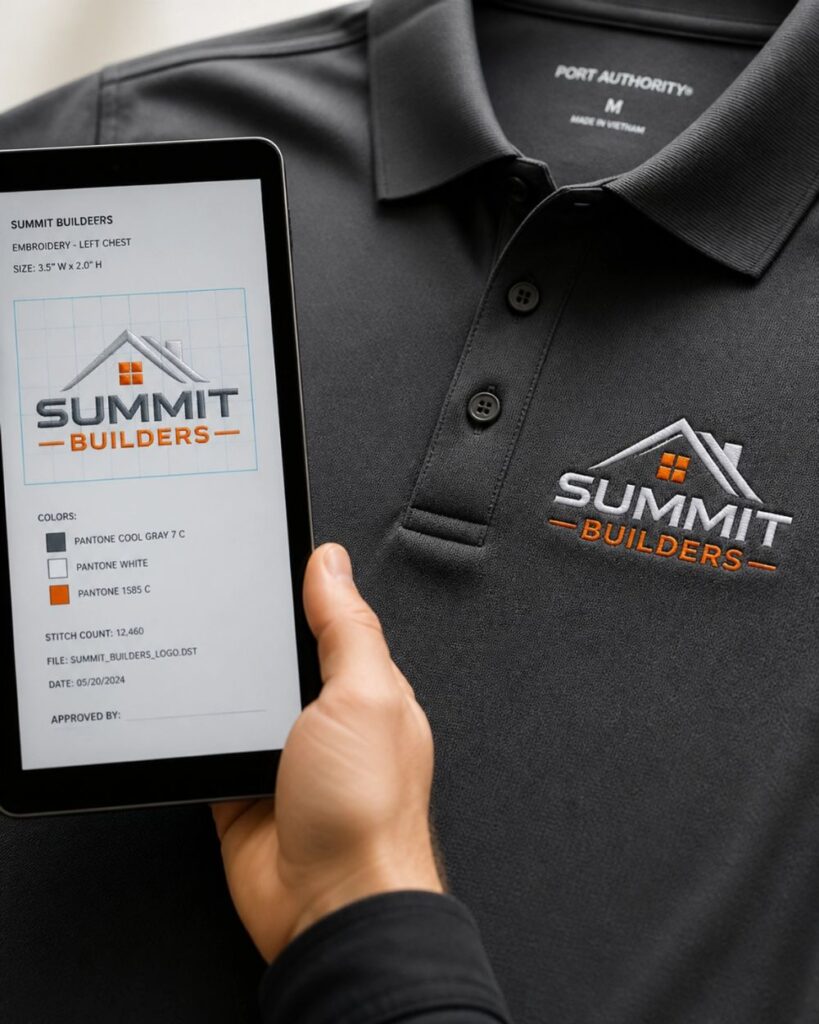
For embroidered work shirts, a clean version of your logo usually works beautifully. Keep the important parts, simplify tiny details, and make sure the words are actually readable at the size you’re ordering.
Custom embroidery services provide a premium, long-lasting look, but embroidery has limits. If your logo has tiny gradients, ultra-fine text, or complex photographic details, it won’t translate well to thread.
- The Mistake: Trying to embroider a highly detailed 12-color landscape onto a small hat or polo chest.
- The Fix: Simplify your “embroidery version” of the logo. Remove small taglines that will become unreadable and stick to solid colors.
| Feature | Best For… | Durability |
|---|---|---|
| Embroidery | Polos, Jackets, Caps | Highest (Lasts the life of the garment) |
| Screen Printing | T-Shirts, Hoodies | High (Great for large back designs) |
| DTG Printing | Full-color photos, small runs | Medium (Best for detail & no-minimums) |
If you’re wondering which option is right for your branded work uniforms, start with the garment and the design. Embroidery is a natural fit for polos, jackets, caps, and professional workwear. Screen printing can shine on larger graphics, while digital printing can be handy for detailed designs and smaller runs.
In other words, don’t force a tiny embroidered logo to do a job better suited to printing. And don’t put a giant, heavy embroidered graphic on a lightweight T-shirt just because you can. The right pairing will look better and feel better.
4. Ignoring Sizing Diversity
This is one area where “close enough” really isn’t close enough. People come in different shapes and sizes, and your uniform order should account for that.
Before placing a large order, give employees a chance to check the sizing information and, if possible, try a sample garment. A shirt that fits comfortably is much more likely to become a shirt someone happily wears all day. And that’s exactly what you want from your custom work uniforms.
- The Mistake: Only ordering “Unisex” sizes and ignoring women’s cuts or tall sizes.
- The Fix: Take a proper tally. Women’s cuts are narrower in the waist and shorter in the sleeve, providing a much more professional silhouette for female staff. At Apparel Pro, we offer a wide range of women’s apparel to ensure everyone feels confident.
5. Choosing Screen Print When You Need Embroidery (and Vice-Versa)
The easiest way to think about it? Don’t choose the decoration first and then hunt for a garment to match it. Start with the garment, the job, and how often it will be washed. Then choose the decoration that makes sense.
For example, embroidered company uniforms can be a lovely choice for polos and jackets, especially when you want a polished, professional look. A large printed design can be a better fit for T-shirts, hoodies, team gear, or promotional apparel.
Screen printing is fantastic for large graphics on t-shirts, but it can crack over time if subjected to the heavy industrial washing that work uniforms often face. Conversely, a giant embroidered logo on the back of a thin t-shirt will be heavy, itchy, and “pucker” the fabric.
- The Mistake: Using screen print for high-frequency wash items like polos or outerwear.
- The Fix: Use Embroidery for professional workwear like jackets and polos. Use Screen Printing for promotional tees or event gear where you need a large, vibrant design on a budget.
And yes, sometimes you can mix and match. Your warehouse team might love a durable hoodie while your front-office team prefers a polo. As long as the branding stays consistent, your whole company can still look like one happy, well-organized team.
6. Falling for "Hidden" Setup Charges
When you’re shopping around for custom business apparel, that little number beside the shirt isn’t always the whole story. Before placing an order, look at the total cost and ask about setup, artwork, digitizing, or other fees that could sneak into the final bill.
Many custom shops lure you in with a low per-shirt price, only to hit you with “digitizing fees,” “screen setup fees,” and “artwork fees” at the final checkout.
- The Mistake: Not calculating the total cost of the order before committing.
- The Fix: Look for transparent pricing. At Apparel Pro, we take pride in having no hidden setup charges. What you see is what you pay, making it easy to stay on budget for your team uniforms.
7. Skipping the Professional Design Check
This is one of those small steps that can save you a very annoying problem later. Your logo might look perfectly sharp on your laptop and still need some attention before it goes onto a shirt, jacket, or hoodie.
A professional design check gives you another set of eyes before production begins. That’s especially helpful when you’re ordering work shirts with a company logo, embroidered workwear, or a large batch of branded employee apparel.
Digital mockups are great, but they don’t catch everything. A low-resolution file might look “okay” on your phone screen but will look pixelated and blurry when printed 10 inches wide on a hoodie.
- The Mistake: Assuming your uploaded file is “print-ready” without an expert eye looking at it.
- The Fix: Always work with a provider that offers a free design check. Our team at Apparel Pro reviews every single order to ensure the resolution is high enough and the colors are optimized for the specific fabric you chose.
And before you click “approve,” give the artwork one last look yourself. Check the spelling, phone number, website, names, and any other tiny details. A 30-second proofread can save you from a very expensive “oops.”
Quick Checklist for Your Next Order
- Environment: Is the fabric breathable enough for the work being done?
- Branding: Is the logo simplified for embroidery or high-res for printing?
- Sizing: Have you included women’s cuts and a range of sizes?
- Quantity: Do you need a bulk order, or are you looking for no-minimum printing for a small team?
- Timeline: Have you left enough time for a quality check and shipping?
- Comfort: Would you actually want to wear this shirt for eight hours? If the answer is “hmm, maybe not,” your employees may feel the same way.
- Decoration: Does the printing or embroidery method suit the garment, logo, and amount of wear it will get?
- Reorders: Can you easily order the same garment and branding again when a new employee joins the team?
Frequently Asked Questions
How many washes will a custom embroidered logo last?
Absolutely! And this can actually be a really smart approach. Different employees have different jobs, so their uniforms don’t necessarily have to be identical from head to toe. Keep the logo, colors, and overall branding consistent, and you can choose garments that make sense for each role.
What if I only need 3 shirts for a small new team?
That’s our specialty. We have a no-minimum order policy, so you can get the same high-quality custom gear whether you need one shirt or one thousand.
What is the best fabric for custom work uniforms?
There isn’t one fabric that’s perfect for every business. For outdoor or physically active jobs, breathable and moisture-wicking materials can be a great fit. For office, retail, and customer-facing roles, structured polos or other polished fabrics may work better. Think about the job first, then choose the fabric.
Should I order samples before placing a bulk custom uniform order?
If you’re ordering uniforms for a larger team, a sample can be a smart little investment. It lets you check the fit, fabric, color, logo size, and placement before committing to a large order. It’s much easier to make a change when you’re looking at one shirt than when you’re staring at a whole box of them.
Are custom work uniforms only useful for large companies?
Not at all. Small businesses can benefit from branded work uniforms just as much as larger companies. A few custom polo shirts or embroidered work shirts can give a small team a consistent, professional look without requiring a huge order.
What's the difference between embroidered and printed work uniforms?
Embroidery is often a great fit for polos, jackets, hats, and other professional workwear, while screen printing can work especially well for larger graphics on T-shirts and hoodies. Digital printing can also be useful for detailed designs and smaller orders. The best choice depends on the garment, artwork, quantity, and how the uniform will be used.
Make Your Team Look Like Pros
Ready to avoid these mistakes and get uniforms your team will actually love to wear?
Get the fit, fabric, branding, and decoration right, and your custom work uniforms can become one of those little details that make your whole business feel more polished. And when your employees actually enjoy wearing them? That’s a win for everyone.
Start designing your custom work uniforms now!